
Introduction: When “Just Work Stress” Becomes Something Darker
How to Recognize a 6 Part of Toxic Work Environment is an important topic for anyone who wants to protect their mental health and professional growth. Understanding the warning signs early can help you avoid stress, burnout, and long-term career damage. In this article, we explore six key signs that can help you identify a toxic workplace and make smarter decisions about your work environment.
You rarely realize you’re in a toxic work place on day one.
It seeps in slowly, like a leak you don’t notice until the floor is warped.
First, it looks like normal pressure:
- A manager who “pushes” you but never acknowledges effort.
- Team meetings that feel like interrogation instead of collaboration.
- That tight knot in your stomach that starts every Sunday afternoon.
You tell yourself:
- “Everyone’s stressed. This is normal.”
- “If I just work harder, it will get better.”
Yet the project ends and the anxiety doesn’t.
You sleep, but you don’t rest.
You log off, but your mind never leaves.
Those are not just “busy season blues.” They are toxic work environment signs.
Unchecked, a toxic workplace can trigger:
- Clinical anxiety or depression
- Burnout and loss of self-worth
- Long-term physical health problems
This guide will help you:
- Understand what actually makes a workplace toxic (and what doesn’t).
- Spot early warning signs in yourself, your team, and your leadership.
- Protect your mental health with practical, science-backed strategies.
- Decide when to escalate, when to stay, and when it’s time to leave.
This is written with a U.S. workplace context in mind, but the principles apply broadly.
Part 1: What Actually Makes a Workplace Toxic?
A high-pressure job is not automatically toxic. Surgical residents, startup teams, ER nurses, trial lawyers, and consultants all work under intense pressure and some of them do so in healthy, supportive environments.
The difference is not the workload.
The difference is the culture and how people are treated.
The 5 Core Features of a Toxic Work Environment
A workplace becomes toxic when the following are normal, not occasional:
- Psychological Insecurity
- You don’t feel safe to speak up, ask questions, or admit mistakes.
- People are punished or humiliated for errors.
- New ideas are shut down with sarcasm or contempt.
- Chronic, Unpredictable Stress
- Priorities change constantly with no explanation.
- You are “firefighting” every day, not doing meaningful work.
- There is no real downtime, ever just brief pauses between crises.
- Lack of Respect and Fairness
- Leaders openly play favorites.
- Bias, discrimination, or inappropriate comments are shrugged off.
- Some people get away with bad behavior because they “bring in money” or “are here longer.”
- Emotional Exhaustion as the Norm
- You leave work mentally empty and emotionally numb most days.
- Even small tasks feel overwhelming.
- You stop caring about quality, growth, or goals; you just want to survive the day.
- Fear-Based Communication
- Threats (“If you can’t handle this, we’ll find someone who can”)
- Public shaming in meetings or group chats
- Passive-aggressive emails, sarcasm, and blame instead of honest dialogue
One bad week or one difficult project does not equal a toxic culture.
Patterns + acceptance from leadership = toxicity.
Part 2: The Psychology Behind Toxic Work places
Your brain does not distinguish much between a physical threat (a car speeding at you) and a constant emotional threat (a boss who may explode at any moment).
In a toxic workplace, your nervous system often lives in fight, flight, freeze, or fawn mode.
What Happens in Your Brain and Body
| Biological Effect | What It Feels Like Day to Day |
| Elevated cortisol (stress hormone) | You feel “wired and tired,” gain weight easily, get sick more often. |
| Amygdala hyper-activation | You’re jumpy, irritable, anxious, and always bracing for bad news. |
| Prefrontal cortex suppression | It’s harder to think clearly, remember details, or be creative and focused. |
| Nervous system dysregulation | You swing between agitation and shutdown; small triggers feel huge. |
In other words:
- You are not “too sensitive.”
- Your brain is reacting exactly how it is designed to respond to repeated threat.
U.S. Data Point:
The American Psychological Association has reported that the vast majority of American workers experience work-related stress, and a significant portion describe their workplaces as toxic or harmful to their mental health.
Toxic workplaces don’t just make you miserable.
They literally reshape your stress response over time.
Part 3: Early Toxic Work Environment Signs Most People Ignore
You can spot a toxic workplace before it completely overwhelms you if you know what to look for. The signs show up in your emotions, your behavior, your relationships at work, and your body.

3.1 Emotional and Mental Red Flags
These often appear long before obvious conflict:
- Persistent “Sunday Scaries”
- Dread starts building on Sunday afternoon and peaks at night.
- You mentally rehearse conversations, imagine worst-case scenarios, or bargain with yourself about calling in sick.
- You Live in Work Mode 24/7
- Constantly checking email, Slack/Teams, or your work phone.
- Feeling guilty or anxious when you’re offline, even during evenings or weekends.
- Emotional Numbness After Work
- You log off and feel nothing no relief, no satisfaction.
- You scroll your phone, binge-watch, or zone out because you have no emotional energy left.
- Crushing Self-Doubt
- You start doubting even skills you used to feel confident about.
- One piece of critical feedback feels like proof that you’re incompetent or failing.
- You Dread Specific People
- You rehearse what to say before talking to your manager or certain coworkers.
- Seeing their name in your inbox or on your calendar makes your stomach drop.
3.2 Communication Red Flags: How People Talk to Each Other
Look beyond what is being said and notice how it’s said, and whether it’s normal.
Fear-Based Communication
- Public call-outs: “Your work on this project was embarrassing” in a group setting.
- Sarcastic digs: “I guess some people don’t know how to read instructions.”
- Constant blame: “You made us look bad” instead of “Let’s figure this out.”
Gaslighting (Reality Manipulation)
Common phrases in toxic, gaslighting environments:
- “You’re too sensitive; everyone else is fine with this.”
- “That conversation never happened.”
- “You’re imagining a problem that isn’t there.”
Over time, you start to:
- Doubt your own memory and instincts.
- Apologize even when you didn’t do anything wrong.
- Feel confused and guilty more than you feel confident.
If you regularly leave conversations thinking, “Am I going crazy?”—pay attention.
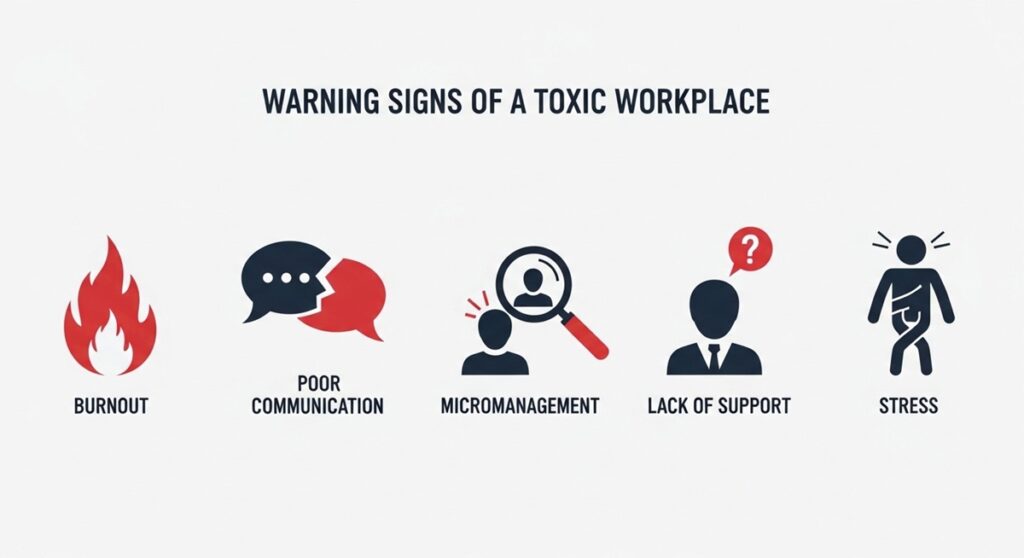
3.3 Leadership Red Flags (The Culture Starts at the Top)
Your manager is the single biggest predictor of your daily experience at work.
| Toxic Leadership Trait | Real-World Example | Impact on You |
| Micromanagement | Approves every email, rewrites all your work. | You feel incompetent and powerless. |
| Lack of transparency | “We’re making changes” with no details or timelines. | You’re always bracing for bad surprises. |
| Emotional volatility | Calm one day, yelling or sulking the next. | You walk on eggshells constantly. |
| Favoritism | One person always gets the best projects and praise. | You stop believing effort equals reward. |
| No accountability | Leaders blame “the team” but never themselves. | You feel scapegoated and disposable. |
Toxic leaders create a climate where:
- People compete instead of collaborate.
- Problems are hidden, not solved.
- The “best” employees are often the most compliant, not the most capable.
3.4 Toxic Coworker Dynamics
Even with a decent manager, toxic coworkers can poison your day-to-day life.
Common patterns:
- Gossip as a bonding tool
- People trade private information to gain status or control.
- You feel pressure to participate or risk being the next target.
- Credit Stealing
- You lead the work; someone else presents it as their own.
- “We” becomes “I” the moment results are good.
- Exclusion and Gatekeeping
- You’re left out of key meetings, email threads, or social events.
- Information is hoarded so others can maintain power or control.
- Sabotage and Unhealthy Competition
- People withhold information so you miss deadlines or look bad.
- Mistakes are celebrated behind your back, not supported.
In many U.S. workplaces, people quit managers and teams more than they quit companies. Research consistently links toxic coworker behavior to higher turnover and burnout.
3.5 Physical Warning Signs: When Your Body Rings the Alarm
Often your body tells the truth before your mind does:
- New or worsening headaches or migraines
- Digestive issues (nausea, cramps, IBS flare-ups) before or during workdays
- Trouble falling or staying asleep; work thoughts keep looping
- Rapid heartbeat, sweating, or shaking before meetings or calls
- Frequent colds, infections, or feeling “run-down” all the time
If these physical symptoms improve on days off, vacations, or when you’re away from certain people, your job may be a major trigger.
Part 4: Toxicity in Remote and Hybrid Work (Modern U.S. Reality)

Toxic culture doesn’t disappear when you go remote it often just becomes harder to see clearly.
Watch for these remote-specific toxic work environment signs:
| Sign | Why It’s Problematic |
| Excessive monitoring tools | Keyloggers, random screenshots, webcam monitoring erode trust and privacy. |
| 24/7 availability expectation | Messages at all hours with implied urgency; no true off-switch. |
| Back-to-back video meetings | No transition time; “Zoom fatigue” and cognitive overload. |
| Remote worker exclusion | Big decisions made in hallway chats or in-office cliques. |
| Vague expectations | No clear priorities; constantly shifting goals over email or chat. |
Remote work should increase flexibility and autonomy.
If it instead increases surveillance, guilt, and burnout, that’s a sign of deeper cultural toxicity.
Part 5: The Mental Health Cost of Staying in a Toxic Workplace
Toxic workplaces are not just “annoying” or “draining” they can trigger serious, diagnosable conditions.
Common Mental Health Outcomes
| Condition | How It Can Show Up in a Toxic Workplace |
| Burnout syndrome | Emotional exhaustion, cynicism, and reduced performance; you feel used up. |
| Generalized anxiety | Constant worry, racing thoughts, panic before work or meetings. |
| Depression | Numbness, hopelessness, no motivation, difficulty getting out of bed. |
| Trauma-related symptoms | Flashbacks of incidents, nightmares, hypervigilance. |
| Low self-esteem | You internalize criticism, feel “never good enough,” fear promotion or visibility. |
Medical organizations such as the Mayo Clinic have linked chronic workplace stress to serious physical illnesses, including heart disease and high blood pressure.
Toxic workplaces are not just “bad fits.” They are genuine health hazards.
Part 6: Your Survival Toolkit – Protecting Yourself While You Decide What’s Next
If you’re in a toxic workplace right now, you may not be able to leave immediately. You may need the income, the healthcare, or the visa sponsorship. That’s real.
While you’re planning your next move, you can still protect yourself.
Step 1: Self-Assessment – Are You in a Toxic Environment?
Use this checklist. If you answer “yes” to 3 or more, treat it as a serious warning.
| Question | Yes / No |
| I feel anxious or heavy dread on Sundays before the workweek. | |
| Mistakes at my workplace are punished, not treated as learning moments. | |
| I regularly dread interacting with my manager or specific coworkers. | |
| My feedback, concerns, or ideas are usually ignored or dismissed. | |
| I feel disrespected, belittled, or talked down to. | |
| I’m expected to be reachable or responsive outside normal hours. | |
| Gossip, blame, or backstabbing are normal on my team. | |
| I feel emotionally empty or drained after most workdays. | |
| I’ve started doubting my abilities and value as a professional. | |
| My physical symptoms (sleep, headaches, stomach issues) have increased. |
This is not a diagnostic tool, but it gives you clarity:
You are not “imagining things.” You’re responding to a pattern.
Step 2: Build Strong Emotional Boundaries
You may not be able to change your boss. But you can change how much of your inner life work can reach.
A. Separate Your Identity from Your Job
Exercise (do this in writing):
- List 5–10 things that define who you are outside of work.
- Example: “Caring parent,” “Good friend,” “Musician,” “Curious learner,” “Runner.”
- Keep this list where you see it daily.
- When work goes badly, deliberately read it and remind yourself:
- “My worth is not decided by this email, this manager, or this company.”
B. Use Neutral, Boundaried Language
When dealing with toxic or aggressive people, respond with facts and requests—not accusations.
Instead of:
- “You never explain anything clearly.”
Try:
- “To make sure I meet expectations, could you clarify what success looks like for this project?”
Instead of:
- “You always email me at night; this is ridiculous.”
Try:
- “I’ve noticed many messages come in after hours. To protect my work quality, I’ll be responding during business hours unless we’ve agreed on an emergency exception.”
This protects your dignity and creates a written record that you are reasonable and professional.
Step 3: Set Digital and Time Boundaries
Especially important for remote or hybrid workers in the U.S., where “always on” has become normalized.
- Turn off notifications from email, Slack, Teams, etc. after your workday ends.
- If possible, use separate phones or at least separate apps (no work email on your main personal inbox).
- Consider an email signature or status note:
- “I respond to messages during regular business hours (e.g., 9–5). If this is urgent, please mark it as such and I’ll address it as soon as I’m able.”
You train others how to treat your time by how you respond.
Step 4: Document Everything (Quietly and Consistently)
A written record is your protection if you need HR support, legal help, or simply clarity for yourself.
Create a “Toxicity Log” on a personal, secure device (not on a work computer):
| Date | Incident (What Happened) | Who Was Involved | Evidence (Email, Chat, etc.) | How It Affected You |
| 05/10/2024 | Manager yelled at me in team meeting; called my work “embarrassing.” | Manager Lee | Meeting invite, witnesses | Humiliated, anxious, lost sleep |
| 05/12/2024 | Coworker took credit for my proposal with leadership. | Coworker Sam | Email thread with attachments | Frustrated, demotivated |
Tips:
- Stick to facts, not interpretations.
- Save emails, chat logs, calendar invites, and performance reviews.
- Avoid documenting on work devices where IT or your employer has access.
If you ever need to escalate or leave, this log becomes invaluable.
Step 5: Build a Support Network (Inside and Outside Work)
You should not navigate a toxic workplace alone.
Consider:
- One trusted colleague – Someone who can reality-check your experiences and, if needed, act as a witness.
- Mentor or career coach – Preferably outside your company for impartial advice.
- Therapist or counselor – Ideally someone familiar with workplace trauma, burnout, or anxiety. (In the U.S., PsychologyToday.com and your insurance directory are good starting points.)
- Employee Assistance Program (EAP) – Many U.S. employers offer free, confidential sessions with counselors. These services do not report details of your conversations to your manager.
Communicate your needs clearly:
- “I’m not looking to gossip; I’m trying to figure out my options and stay healthy.”
Step 6: When and How to Escalate
Escalation is serious and should be done thoughtfully and with documentation.
You should strongly consider escalating when:
- There is harassment, bullying, or discrimination.
- There are threats to your physical safety.
- You witness illegal behavior (fraud, dangerous safety violations, etc.).
- You have tried direct communication and conditions have not improved.
Basic escalation path (U.S. context):
- If safe, speak directly to the person using neutral, specific language.
- Document the conversation (date, time, what was said).
- Escalate to your manager or HR with specific incidents and your toxicity log.
- If HR does not protect you, consider consulting an employment attorney or relevant agency (e.g., EEOC for discrimination/harassment in the U.S.).
Always remember: HR exists to protect the organization first. They can be helpful, but they are not the same as your therapist or advocate. Documentation is your leverage.
Part 7: Knowing When It’s Time to Leave (And How to Do It Safely)
Not every toxic workplace can be fixed. Sometimes the healthiest, bravest move is to go.
Strong signs it’s time to leave as soon as realistically possible:
- You are being harassed or discriminated against, and leadership does not act.
- You are being gaslit to the point you doubt your own sanity.
- Your mental health is deteriorating despite therapy, boundaries, and coping strategies.
- Your physical health is seriously affected (e.g., panic attacks, recurring illness).
- You’ve given clear feedback, nothing changes, and leadership doesn’t seem to care.
Leaving is not “quitting” in the moral sense. It is self-preservation.
Exit Strategy: Protect Yourself on the Way Out
- Update your résumé and LinkedIn before giving any notice.
- Quietly network with former colleagues, friends, and contacts. Let them know you’re open to opportunities.
- Use PTO strategically for interviews and recovery when possible.
- Secure important info (contact lists, portfolio pieces) that you are legitimately allowed to take.
- Give standard notice (often two weeks in the U.S.) unless an attorney or mental health professional advises otherwise.
- Keep exit interviews professional:
- Be honest but factual.
- Avoid venting; remember who HR ultimately serves.
Example script for an exit interview:
“I’ve appreciated X and Y about working here. I’m leaving because the workload and communication style on my team have impacted my wellbeing in ways that don’t feel sustainable. I hope sharing this helps the organization improve.”
You do not owe anyone your trauma story.
Part 8: Healing After You Leave a Toxic Workplace
Leaving the environment is step one. Healing is step two.
1. Allow Yourself to Decompress
Expect an adjustment period. Many people feel:
- Exhausted, even in better jobs
- Hypervigilant (“Is my new boss going to explode?”)
- Guilty or ashamed for “lasting so long” or “not leaving sooner”
This is normal. Your system is recalibrating from chronic stress.
2. Consider Therapy or Counseling
Therapeutic approaches that often help with toxic workplace trauma:
- CBT (Cognitive Behavioral Therapy): Challenge internalized beliefs like “I’m incompetent” or “I have to please everyone to be safe.”
- EMDR or trauma-focused therapy: Process specific incidents of humiliation, bullying, or abuse.
- Somatic approaches: Reconnect with your body and release stored tension.
3. Rebuild Your Identity Outside of Work
- Re-engage with hobbies you neglected.
- Spend time with people who knew you before this job.
- Volunteer, take a short course, or pursue interests that remind you of your capabilities and values.
4. Reset Your Boundaries in the Next Job
Use your past experience as data:
- What were your early warning signs that you ignored?
- Which boundaries did you wish you had set sooner?
- What will you no longer tolerate, even if the salary is high?
Write this down and review it before accepting new offers.
Part 9: How to Spot a Healthy Workplace (Before You Say “Yes”)

You can’t eliminate all risk, but you can look for “green flags” during your job search.
Green Flags in Interviews and Research
- Leaders talk about psychological safety and can give concrete examples (e.g., “We do blameless post-mortems after mistakes.”).
- People describe their manager as “supportive,” “clear,” and “respectful,” not just “brilliant” or “demanding.”
- The company has reasonable expectations for hours and truly respects time off.
- Turnover on the team is relatively low, and people have stayed more than 1–2 years.
- There are clear performance expectations, feedback processes, and growth paths.
Questions you can ask (and why they matter):
- “How does the team handle it when someone makes a mistake?”
- Look for learning and problem-solving, not shaming.
- “Can you describe your management style and how you like to give feedback?”
- Listen for specificity and emotional intelligence.
- “What does work–life balance look like for people in this role?”
- Watch whether they hesitate, laugh it off, or give vague answers.
- “Why did the person in this role leave?”
- Honest, respectful answers are a good sign; evasiveness is not.
If answers are vague, defensive, or inconsistent between interviewers, consider it a warning.
Part 10: FAQ – Quick Answers About Toxic Work Environment Signs
1. What are the top 10 toxic work environment signs?
- Constant dread about work
- Fear of your manager or certain coworkers
- Public shaming or belittling
- Gossip, blame, and backstabbing
- Micromanagement and lack of trust
- No clear expectations, shifting priorities, chronic chaos
- Bias, harassment, or discrimination that goes unchecked
- Being “always on” with no respect for personal time
- Emotional exhaustion and numbness most days
- New or worsening physical symptoms tied to workdays
2. Can a toxic workplace really affect my mental health?
Yes. Long-term exposure to toxic workplaces is linked to anxiety, depression, burnout, and even trauma-like symptoms. Organizations like the APA and NIMH routinely highlight workplace stress as a major mental health risk factor.
3. Should I quit a toxic job without another one lined up?
It depends on your financial and personal situation. For some people, staying is more harmful than the instability of leaving. For others, the safest choice is to:
- Set a clear timeline
- Save a financial cushion if possible
- Job search quietly while still employed
Talking with a therapist or trusted advisor can help you decide.
4. How do I know if I’m the problem, not the workplace?
Ask yourself:
- Do I have similar issues everywhere I go, or is this new?
- Have I asked for specific feedback and tried to improve?
- Are multiple people describing the same toxic patterns, or is it “just me”?
Often in truly toxic environments, many people share similar experiences—especially over time.
5. Can a toxic workplace get better?
Sometimes, but only if leadership:
- Acknowledges the problem
- Changes structures (not just slogans)
- Holds toxic people accountable
If leadership minimizes your experience or punishes those who speak up, lasting change is unlikely.
Read ou comple post: How to Meditate Mindfulness for Inner Peace to help you on improve you wellbeing.
Authoritative External References (USA-Focused)
Use these sources to support and fact-check your understanding:
- American Psychological Association (APA) – Work and Stress
https://www.apa.org/topics/workplace - Mayo Clinic – Handling Job Stress
https://www.mayoclinic.org/healthy-lifestyle/adult-health/in-depth/stress/art-20046037 - Society for Human Resource Management (SHRM)
https://www.shrm.org/ - National Institute of Mental Health (NIMH) – Stress
https://www.nimh.nih.gov/health/topics/stress - Harvard Business Review – Toxic Workplaces & Culture
https://hbr.org/topic/workplace-culture/toxic-workplaces
Final Thoughts: Your Mental Health Is Non-Negotiable
If you recognize yourself in these toxic work environment signs, it does not mean you are weak. It means your mind and body are working exactly as they should in the face of ongoing threat.
Your job is a part of your life not your entire worth.
You are allowed to want safety, respect, and basic human dignity at work.
Notice the signs.
Protect yourself.
And when you’re ready, choose environments that let you not just survive but actually grow.