
Simple self-care routines for busy days seem like an impossible luxury when your schedule is packed. Between meetings, deadlines, family responsibilities, and endless commitments, taking care of yourself always ends up at the bottom of your priority list.
What Is Self-Care and Why It Matters on Busy Days
Self-care goes far beyond expensive spas and restful weekends. At its core, self-care is any intentional action that nurtures your physical, mental, or emotional health.
The Real Definition of Self-Care
The World Health Organization defines self-care as the ability of individuals, families, and communities to promote health, prevent disease, and maintain well-being with or without the support of healthcare professionals.
This means self-care is not selfishness. It’s basic maintenance of your human operating system.
When you’re too busy to take care of yourself, you’re actually:
- Reducing your cognitive capacity
- Increasing cortisol levels (the stress hormone)
- Compromising your immune system
- Decreasing your actual productivity
Why Busy People Need Self-Care More
It seems contradictory, but the busier you are, the more essential self-care becomes.
Research published in the Journal of Occupational Health Psychology shows that workers who practice micro-moments of recovery throughout the day experience:
- 40% fewer burnout symptoms
- Better sleep quality
- Higher job satisfaction
- Lower turnover rates
The secret isn’t about finding time it’s about using differently the time you already have.
5-Minute Morning Routines to Start Your Day Right
The morning sets the tone for your entire day. Chronobiology studies show that the first actions after waking up program your nervous system for the hours ahead.
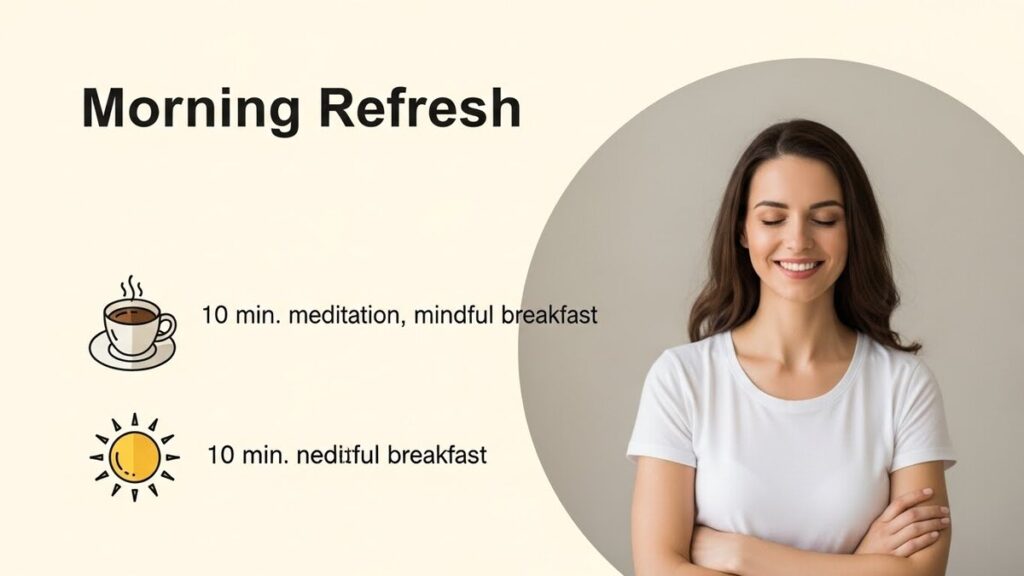
You don’t need to wake up at 5 AM to have a powerful morning routine. You just need 5 intentional minutes.
The Conscious Awakening Technique (2 Minutes)
Before grabbing your phone before anything else practice conscious awakening:
- Take 3 deep breaths (30 seconds)
- Stretch your body while still lying down: arms above your head, legs extended (30 seconds)
- Set a simple intention for the day one word or short phrase (30 seconds)
- Express gratitude for something specific: it can be as simple as “hot coffee” (30 seconds)
This sequence activates your parasympathetic nervous system (rest and digest mode) instead of the sympathetic (fight or flight mode).
Strategic Hydration (1 Minute)
Your body lost water during 7-8 hours of sleep. A glass of room-temperature water:
- Boosts your metabolism by up to 24% for the next 90 minutes
- Improves cognitive function
- Helps eliminate toxins
- Reduces morning fatigue
Practical tip: Leave a glass or bottle on your nightstand the night before.
Minimum Viable Movement (2 Minutes)
You don’t need an hour of exercise. Two minutes of intentional movement already make a measurable difference:
Option A: Basic Stretching:
- 30 seconds: neck rotations
- 30 seconds: shoulder rolls
- 30 seconds: seated spinal twist
- 30 seconds: calf stretch
Option B: Energy Activation:
- 30 seconds: light jumping jacks
- 30 seconds: simple squats
- 30 seconds: high knees
- 30 seconds: deep recovery breathing
These micro-movements increase blood flow, oxygenate the brain, and prepare the body for action.
Strategic Micro-Breaks During Work
The workday is where most people completely abandon self-care. Ironic, because it’s exactly when we need it most.
Productivity science shows that the human brain wasn’t designed for continuous focus for hours. We work in ultradian cycles of approximately 90-120 minutes.
The 52-17 Technique (Research-Validated)
A DeskTime study of the most productive workers revealed a pattern: they worked an average of 52 minutes and took breaks of 17 minutes.
You don’t need to follow these exact times. The principle is:
- Focused work → Intentional break → Focused work
For extremely busy days, try the micro version:
- 25 minutes of focus – 5-minute break (Pomodoro Technique)
- 45 minutes of focus – 10-minute break
What to Do During Micro-Breaks
Effective breaks don’t include social media. They include:
2-minute break:
- Look out the window (rests eyes and resets focus)
- 4-7-8 breathing (inhale 4 seconds, hold 7, exhale 8)
- Neck and shoulder stretching at your desk
5-minute break:
- Walk to the kitchen for water or tea
- Go up and down a flight of stairs
- Listen to one complete song with eyes closed
- Take 10 deep breaths by the window
10-minute break:
- Short outdoor walk
- Nutritious snack consumed without screens
- Brief conversation with colleague about non-work topic
- Short guided meditation (apps: Headspace, Calm, Insight Timer)
Automatic Alerts and Reminders
Your busy mind will forget about breaks. Set up reminders:
- Phone alarms every 90 minutes
- Browser extensions like “Stretchly” or “Time Out”
- Smartwatch with movement reminders
- Visible post-it on your monitor
Automation removes the need for willpower.
Automatic Alerts and Reminders
Your busy mind will forget about breaks. Set up reminders:
- Phone alarms every 90 minutes
- Browser extensions like “Stretchly” or “Time Out”
- Smartwatch with movement reminders
- Visible post-it on your monitor
Automation removes the need for willpower.
Mindful Eating on Chaotic Days
When we’re busy, food becomes the first casualty. We skip meals, eat in front of the computer, choose ultra-processed options for convenience.
The problem: poor nutrition worsens your ability to handle busy days.
The Myth of Not Having Time
You probably spend more time deciding what to eat than it would take to prepare something nutritious.
Uncomfortable truth: a whole-grain sandwich with protein takes 3 minutes to make. Ordering delivery takes 40 minutes to arrive.
The problem isn’t time it’s planning and pre-made decisions.
Eating Strategies for Busy People
1. Minimal Meal Prep (Sunday – 30 minutes)
You don’t need to cook 5 complete meals. Just prepare the components:
- Protein in bulk (shredded chicken, boiled eggs, legumes)
- Washed and cut vegetables
- Cooked grains (brown rice, quinoa)
- Portioned snacks (nuts, fruits, yogurt)
When it’s time to eat, just assemble.
2. The 2-Minute Plate Rule
If you only have 2 minutes, assemble a plate with:
- 1 protein source (egg, cheese, hummus)
- 1 vegetable or fruit
- 1 complex carbohydrate (whole grain bread, oatmeal)
Nutritionally superior to any fast food.
3. Strategically Pre-Positioned Snacks
Leave healthy options where you work:
- Drawer: nuts, dried fruits, protein bars
- Office fridge: yogurt, fruits, cut vegetables
- Bag/backpack: water, emergency snack
When hunger strikes, the healthy option will be the easiest.
Eating With Attention (Even With Only 10 Minutes)
Eating in front of screens increases caloric consumption by up to 25% and decreases satisfaction.
Minimum rule: The first 5 bites without distraction. Look at the food. Chew. Taste the flavor.
Even if you need to check emails afterward, those first moments of attention improve digestion and satisfaction.
Breathing Techniques for Immediate Stress Relief
Breathing is the only bodily function you consciously control AND that directly affects your autonomic nervous system.
This means: you can hack your stress in seconds, just by breathing differently.
The Science Behind Breathing
When you’re stressed, your breathing becomes fast and shallow (thoracic). This signals danger to the brain, which keeps alert mode activated.
Slow, deep breathing (diaphragmatic) activates the vagus nerve, sending safety signals. Cortisol decreases. Heart rate slows. The mind clears.
You don’t need to meditate. You just need to breathe with intention for 60-120 seconds.
4 Techniques to Use Anywhere
1. 4-7-8 Breathing (Dr. Andrew Weil)
- Inhale through your nose counting to 4
- Hold counting to 7
- Exhale through your mouth counting to 8
- Repeat 4 cycles
Best for: anxiety, difficulty sleeping, nervousness before meetings.
2. Box Breathing (Navy SEALs)
- Inhale counting to 4
- Hold counting to 4
- Exhale counting to 4
- Hold (empty lungs) counting to 4
- Repeat 4-6 cycles
Best for: focus before important tasks, calm under pressure.
3. Physiological Sigh (Stanford)
- Inhale deeply through your nose
- Take a second short inhale (completely filling lungs)
- Exhale slowly through your mouth
- Repeat 3-5 times
Best for: quick relief from acute stress, anger control.
4. Simple 5-5-5 Breathing
- Inhale counting to 5
- Exhale counting to 5
- Repeat 5 times
Best for: beginners, discreet use in public, transitions between tasks.
When to Use Each Technique
| Situation | Recommended Technique |
| Before sleep | 4-7-8 |
| Before important meeting | Box Breathing |
| Acute stress/panic | Physiological Sigh |
| Task transitions | Simple 5-5-5 |
| Traffic/waiting | Any of them |
Also read: How to Reduce Stress Naturally and Consciously
Digital Self-Care: Managing Screens and Notifications
Our devices are designed to capture attention. Notifications, colors, sounds everything engineered to keep us connected.
The problem: this constant connection is a significant source of stress and mental exhaustion.
Modern self-care includes actively managing your relationship with technology.
The Hidden Cost of Constant Connectivity
Researchers at the University of California discovered that:
- It takes an average of 23 minutes to regain focus after an interruption
- We check our phones 96 times per day on average
- Each “quick” social media check lasts an average of 2-3 minutes
Do the math: 96 checks × 2.5 minutes = 4 hours daily lost.
Digital Hygiene Strategies
1. Notification Audit (Do Once)
Take your phone right now. Go to Settings > Notifications.
For each app, ask:
- Does this notification require immediate action?
- Can this wait until I actively check?
Keep notifications only for:
- Calls from priority contacts
- Messages from essential people
- Calendar appointments
Disable everything else. You can check when you choose.
2. Screen-Free Zones and Times
Create simple rules:
- First hour of the day: no social media
- Last hour before sleep: no screens (or night mode + calm content)
- Meals: phone on silent, away from the table
- In-person meetings: phone put away
3. Intentional vs. Reactive Use
The difference:
- Reactive: picking up phone because it beeped / out of boredom / out of habit
- Intentional: opening phone for specific task, closing when done
Before picking up the device, ask: “What specifically am I going to do?”
4. Digital Self-Care Ally Apps
- Forest: gamifies focus, plants virtual trees while you don’t use your phone
- Screen Time (iOS) / Digital Wellbeing (Android): monitors usage, allows limits
- Freedom: blocks sites and apps for defined periods
- Opal: groups distractions, creates focus sessions
Evening Routine for Recovery and Quality Sleep
Sleep is the most underrated pillar of self-care. During sleep, your body:
- Consolidates memories and learning
- Repairs muscle tissue
- Regulates appetite and stress hormones
- Strengthens the immune system
A good night’s sleep doesn’t start when you lie down. It starts hours before.
The Importance of Wind-Down
Your body doesn’t work like a switch. You can’t go from “work mode” to “sleep mode” instantly.
The nervous system needs gradual transition. Sleep specialists call this sleep hygiene.
30-Minute Evening Routine (Flexible)
You don’t need to do everything. Choose what works for you:
60-90 minutes before bed:
- Last heavy meal (digestion interferes with sleep)
- Last caffeine dose should be ~8 hours before
- Dim house lights (signals to brain that night has fallen)
30-60 minutes before:
- Turn off screens or activate blue light filter
- Relaxing activities: reading, calm podcast, light conversation
- Warm bath (the body temperature drop afterward induces sleep)
15-30 minutes before:
- Prepare environment: dark, cool (64-70°F ideal), quiet
- Relaxation technique: breathing, gentle stretching, body scan
- Avoid arguments or stressful news
In bed:
- 4-7-8 technique to induce relaxation
- If thoughts race: write on paper beside bed to “empty” the mind
- Don’t check the time (increases anxiety)
The Power of Consistent Ritual
More important than the specific elements is consistency.
When you repeat the same sequence night after night, your brain learns to associate these actions with sleep. Over time, the ritual alone induces sleepiness.
Start with just 2-3 elements. Add others gradually.
Solution for Those Who Can’t “Switch Off”
If your mind races at night:
1. Brain Dump
Paper and pen beside the bed. Write everything that’s in your head: tasks, worries, ideas. Don’t organize. Just dump.
2. Tomorrow’s List
Write the 3 most important tasks for the next day. This tells your brain: “It’s recorded. You can rest.”
3. Scheduled Worry
If you tend to ruminate, set aside 15 minutes earlier in the day (not at night) to “officially worry.” When anxious thoughts arise at night, say: “That’s for tomorrow’s worry time.”
Emotional Self-Care: Quick Practices for Mental Balance
Physical self-care gets more attention, but caring for emotions is equally vital especially on stressful days.
You don’t need therapy to practice basic emotional hygiene (though therapy is excellent when possible).
2-5 Minute Practices for Emotional Balance
1. Emotional Check-In (2 minutes)
Three times a day, pause and ask:
- What am I feeling right now? (name the emotion)
- Where in my body do I feel this? (chest tension? stomach tightness?)
- What does this emotion need? (rest? movement? expression?)
Simply naming emotions reduces their intensity a phenomenon neuroscientists call “affect labeling.”
2. Specific Gratitude (3 minutes)
Not just “I’m grateful for my family.”
Be specific: “I’m grateful for the coffee my partner made this morning, without me asking, because they noticed I was tired.”
Specificity activates the brain’s reward system more.
Do this:
- Upon waking (3 things you’re looking forward to)
- Before sleep (3 good things that happened)
3. Quick Journaling (5 minutes)
You don’t need to write pages. Try:
- Light Morning Pages technique: 1 page of free writing, no editing
- 3 questions: What am I feeling? What do I need? What can I do?
- Complete sentences: “Today I feel…” / “I need…” / “I will…”
Writing processes emotions that get “stuck” when we just think about them.
4. Active Self-Compassion (2 minutes)
When you make a mistake or feel inadequate:
- Acknowledge the suffering: “This is hard”
- Remember common humanity: “Everyone goes through this”
- Offer kindness: “What would I say to a friend in this situation?”
Researcher Kristin Neff demonstrated that self-compassion increases resilience more than self-esteem.
Signs You Need Professional Support
Self-care practices are maintenance, not treatment.
Consider seeking professional help if:
- Symptoms persist for more than 2 weeks
- They significantly interfere with work or relationships
- They include thoughts of self-harm
- They involve substance use to cope
Building Sustainable Habits: How to Maintain Consistency
Knowing what to do is easy. Doing it consistently is the real challenge.
Most people fail not from lack of information, but from lack of system.
Why Motivation Doesn’t Work
Motivation is a fluctuating resource. Some days you wake up energized; others, exhausted.
Depending on motivation for self-care is like depending on weather to leave the house too inconsistent.
The alternative: systems and environment.
Strategy 1: Habit Stacking
Connect new habits to existing habits:
- After brushing my teeth → I take 5 deep breaths
- While coffee is brewing → I stretch
- Before opening email → I drink a glass of water
- When I sit down for lunch → first 5 bites without screen
The structure “WHEN [existing habit], I WILL [new habit]” is more effective than fixed schedules.
Strategy 2: Reduce to the Ridiculously Minimal
The common mistake: “I’ll meditate 20 minutes per day.”
Reality: you don’t do it and feel guilty.
The solution: start ridiculously small.
- Meditation: 1 minute (60 seconds)
- Exercise: 2 stretches
- Gratitude: 1 thing
- Reading: 1 page
- Hydration: 1 extra glass
After being consistent (2+ weeks), gradually increase.
It’s better to do a little every day than a lot occasionally.
Strategy 3: Environment Design
Modify your environment to facilitate good habits and make bad ones difficult:
Make it easy (self-care):
- Visible water bottle on desk
- Exercise clothes separated the night before
- Breathing app on home screen
- Healthy snacks at eye level
Make it difficult (harmful habits):
- Phone charging in another room at night
- Social media off home screen
- Unhealthy snacks on high shelf, behind other items
- Work physically separated from rest area
Strategy 4: The Two-Day Rule
You will fail. Days that are too busy happen.
The rule: never fail two days in a row.
One missed day is an accident. Two days is the beginning of a new pattern.
If yesterday you didn’t do anything, today do at least the minimum version.
Practical Plan: Building Your Personalized Routine
Theory is useful. But you need an applicable plan.
Let’s build a complete self-care routine for busy days 15 minutes daily, spread throughout the day.
15 Minutes/Day Routine Template
| Moment | Duration | Practice | Options |
| Upon waking | 2 min | Conscious awakening | Breathing + intention |
| Morning | 1 min | Hydration | Room temperature water |
| Mid-morning | 2 min | Micro-break | Stretching or breathing |
| Lunch | 5 min | Mindful eating | First bites without screen |
| Mid-afternoon | 2 min | Micro-break | Walking or breathing |
| Before bed | 3 min | Wind-down | Gratitude or journaling |
Total: 15 minutes spread out = completely doable even on the most chaotic days.
Emergency Version (5 Minutes)
Days of absolute chaos? Choose just ONE:
- Morning: 3 deep breaths + glass of water
- Midday: 2 minutes of walking + stretching
- Night: 5 mental gratitudes before sleeping
Something is infinitely better than nothing.
How to Personalize for Yourself
Different people have different needs:
If you’re anxious: prioritize breathing and digital limitation
If you’re physically exhausted: prioritize hydration, nutrition, sleep
If you work sitting: prioritize movement and micro-breaks
If you’re mentally overloaded: prioritize journaling and emotional check-in
If you have insomnia: prioritize evening routine and sleep hygiene
Experiment for 2 weeks. Observe what makes a difference. Adjust.
Frequently Asked Questions (FAQ)
How much time do I need for self-care per day?
There’s no rigid scientific minimum, but research suggests that 10-15 minutes of intentional practices spread throughout the day already produce measurable benefits. What matters is consistency, not quantity. Accumulated 2-3 minute micro-moments outperform occasional long sessions.
Is self-care selfish?
Absolutely not. Self-care is basic maintenance that allows you to function well for yourself and others. Research shows that people who practice regular self-care are more productive at work, better in relationships, and more available to help others. You can’t give what you don’t have.
How can I practice self-care without spending money?
The most effective practices are free: breathing, movement, adequate sleep, hydration, social connection, time in nature, gratitude. Expensive products and experiences are marketing, not necessity. Start with what you already have available.
Does self-care really work for chronic stress?
Self-care practices help manage stress, but they don’t replace structural changes when the problem is systemic (toxic job, abusive relationship, untreated health conditions). Self-care is a complement, not a substitute for solving root causes. If stress persists, consider professional support.
How do I maintain my routine while traveling or on atypical days?
Have a minimal portable version: 3 deep breaths, an extra glass of water, 5 minutes of stretching, mental gratitude before sleeping. These practices don’t depend on location or equipment. Consistency comes from flexibility, not rigidity.
Do I need to wake up earlier to have a self-care routine?
Not necessarily. The most effective self-care is distributed throughout the day, not concentrated in one specific hour. 2-3 minute micro-breaks during work, mindful eating, breathing before meetings all of this counts. Optimize the time that already exists instead of creating new blocks.
Conclusion: Small Actions, Real Transformation
Simple self-care routines for busy days don’t require a revolution in your schedule. They require intention.
In this guide, you learned:
- 5-minute morning routines that set the tone for the day
- Strategic micro-breaks that restore focus and energy
- Mindful eating even with limited time
- Breathing techniques for immediate stress relief
- Digital hygiene to protect your attention
- Evening routines that ensure real recovery
- Emotional practices for mental balance
- Habit systems that guarantee consistency
The next step is to start small.Choose one practice. Just one. Do it for 7 days.
Then, add another.
In a month, you’ll have a complete self-care routine that fits into your real life not an idealized version that doesn’t exist.
Taking care of yourself isn’t a luxury. It’s a prerequisite for everything else you want to do and be.
Start today. Start now. Start with one deep breath